

Wednesday, February 24, 2010


Monday, February 15, 2010
A Note to Clueless Climate Deniers

By Dr. Phillip Neches
http://www.huffingtonpost.com/dr-philip-neches
As the East digs its way out of another massive snow storm, some are led to wonder how so much snow is possible when we're supposed to be having global warming. Some people just don't want to believe in global warming. Others are just struck by the seeming incongruity. To see how it works, try this little catechism:
What is snow? Frozen water falling from the sky.
How does water get into the sky? It evaporates, mostly from the ocean.
What makes water evaporate from the ocean? Heat from the sun.
What is global warming? More heat from the sun is trapped near the Earth's surface.
Would global warming cause more or less water to evaporate from the ocean? More, obviously.
And that, in short, is why global warming causes more snow, as long as there is enough cold Arctic air to freeze the water. Otherwise, it would be flooding rain.
Climate scientists love to discuss their theories, observations, and models, which give more richness and detail to a terribly complex subject. But this little catechism is, as they say, "good enough for government work." At least, it's good enough for voters to understand which politicians espouse policy based on how the real world works, and which are talking from what they would like to believe, true or not.
Tuesday, February 9, 2010
Local Democracy Under Siege
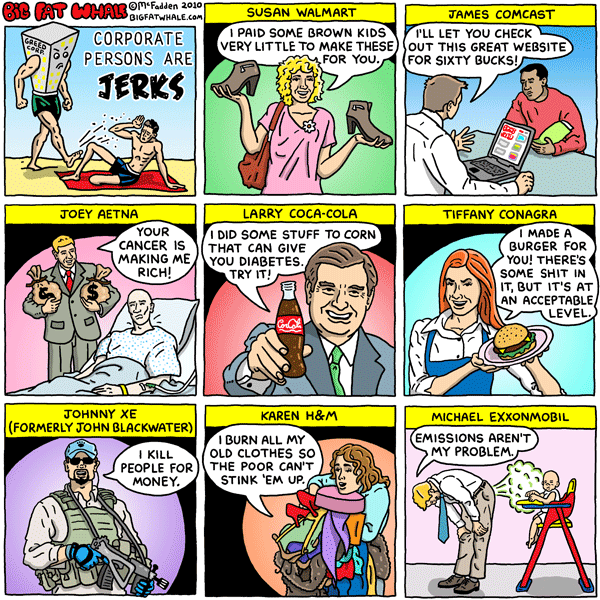
With the recent ruling on Citizens United vs. the F.E.C., the Supreme Court has opened the floodgates on corporate cash, allowing the titans of industrial energy, agriculture, extraction and development to pump even more money into the election system. What to do?
Marine biologist, and Bioneers alum Riki Ott, author of Not One Drop - Betrayal and Courage in the Wake of the Exxon Valdez Oil Spill, has issued an impassioned call to action for local communities to take a stand against corporate personhood. You can join Riki's efforts at movetoamend.org.
Another friend of Bioneers, Jeffrey Clements, is giving his time to serve as general counsel to Free Speech to the People, a grassroots organization working to return the First Amendment to its rightful place, empowering individual citizens.
Bioneers founder Kenny Ausubel has spoken out about the threat of corporate speech to local democracy before. Read what he's had to say, and check out this useful list of how corporate consolidation is increasingly putting the power in the hands of fewer and fewer individuals.
_________________________________________________
Grassroots Mobilization:
_________________________________________________
Grassroots Mobilization:
A Call for Communities to Defy the Court
But that's not the worst of it. This decision actually goes far beyond the circular legal argument that, since the court has ruled previously that free speech equals money, limiting corporations from spending money to influence elections has a chilling effect on free speech (money). If this is confusing, don't worry it's not you. The court had to reach for this.
Citizens United is merely the last straw in a haystack of (successful) corporate attempts to extend corporate constitutional "rights" to corporate persons ever since the U.S. Supreme Court blurred the distinction between "natural persons," or real living human beings, and "artificial persons" -- corporations -- in 1886.
Since the 1886 Santa Clara decision, literally hundreds -- perhaps thousands -- of local, state, federal, and international laws that attempt to protect our environment, our elections, our safety and health, and our right to organize have been overturned as a result of this doctrine. Armed with human rights and legal privileges, corporations have amassed enormous wealth and power and disabled democracy on all three branches of our government. Even a partial list shows the range of regulations falling to the new corporate rights doctrine, from those concerning clean and fair elections; to environmental protection and energy; to tobacco, alcohol, pharmaceuticals, and health care; to consumer protection, lottery, and gambling; to race relations - and more!
Our Republic and democratic process has been hijacked by corporations through illegitimate usurpation of rights intended for human persons. This is a call to action! It is time to change the rules.
What can people do? When Congress passed the USA Patriot Act that undermined civil rights and civil liberties, hundreds of communities, some counties, and at least three states adopted Anti-Patriot Act measures. Similarly, but on a bigger scale, we could start a grassroots movement at the local level to pass municipal legislation or resolutions that defy the Court and strip corporations of their personhood (human rights) status. We could strike any corporate personhood language from State law -- or State constitutions, a harder process.
It is fine that for-profit corporations and other business entities exist, but they should exist to serve people. Corporations are not people and they should not be guaranteed the rights of people. A legislature can give corporations whatever privileges deemed appropriate, but granting corporations the legal status of living, breathing, and eventually dying, natural persons is a grave mistake. Their huge wealth, coupled to human rights, makes corporations far more powerful than people.
Action to abolish corporate personhood (e.g., artificial persons with human rights) in a municipalities, counties, and states could be the forefront of a movement to push this issue right back to the federal level and force Congress to consider amending the U.S. Constitution to do the same.
People could also join the largest and most politically, geographically, and racially diverse coalition to respond to the Citizens United case. The Campaign to Legalize Democracy aims to amend the U.S. Constitution to end the illegitimate legal doctrines that prevent the American people from governing ourselves. First and foremost, the campaign will move to amend that only human beings are entitled to constitutional rights.
Within one day of the decision's release, over 20,000 Americans had signed on to the Motion to Amend the Constitution. This campaign aims to fix the root of the problem - corporate personhood - not only the symptoms like campaign financing, election financing, and free speech issues that were raised in the Citizens United case.
The main thing is to get involved with the grassroots movements to protect democracy from unchecked corporate power.
It cannot be overstated: The ruling in Citizens United leaves ordinary citizens little power to keep corporate influence out of democratic decision making. We must unite to reverse this outrageous ruling -- and the underlying morally wrong premise that corporations and other artificial persons are entitled to real human rights.
All aboard for democracy!
Riki Ott is director of Ultimate Civics, a co-organizer of the Campaign to Legalize Democracy. She lectures nationally on the democracy crisis. Learn more and sign the motion to amend the Constitution to affirm rule by the people, not corporations!
Constitutional Amendment Heating Up
Outside, Washington, D.C. is smothered in near-record amounts of snow. But inside - inside the halls of government, to be specific - things are heating up.
The Supreme Court ruled last month that corporations can spend unlimited amounts of money in our elections.
You already joined the fight to defend our democracy from a corporate takeover by signing Public Citizen's petition for a constitutional amendment to counteract this radical ruling.
I'm asking you to help grow the resistance by forwarding this email to 10 friends and family members and asking them to sign the petition, too.
We must preserve First Amendment rights for actual people and the press. The First Amendment was never intended to apply to artificial constructs like profit-hungry corporations.
Many members of Congress are introducing amendments and signaling their support, including Representatives Donna Edwards, John Conyers, Marcy Kaptur, Leonard Boswell and Dennis Kucinich, and Senators John Kerry, Arlen Specter and Chris Dodd.
A real movement is taking shape.
Our petition is already 45,000 citizens strong. People instinctively recognize the Supreme Court's decision for the disaster that it is.
But constitutional amendments do not come easy. We need a groundswell of support from every corner of the nation. We need hundreds of thousands of people to drive the legislative push in Congress.
The first step is building our petition.
Please forward this letter to at least 10 friends and family members today. Ask them to visit DontGetRolled.org and sign the petition, too.
Thank you,
Robert Weissman, President
The Supreme Court ruled last month that corporations can spend unlimited amounts of money in our elections.
You already joined the fight to defend our democracy from a corporate takeover by signing Public Citizen's petition for a constitutional amendment to counteract this radical ruling.
I'm asking you to help grow the resistance by forwarding this email to 10 friends and family members and asking them to sign the petition, too.
We must preserve First Amendment rights for actual people and the press. The First Amendment was never intended to apply to artificial constructs like profit-hungry corporations.
Many members of Congress are introducing amendments and signaling their support, including Representatives Donna Edwards, John Conyers, Marcy Kaptur, Leonard Boswell and Dennis Kucinich, and Senators John Kerry, Arlen Specter and Chris Dodd.
A real movement is taking shape.
Our petition is already 45,000 citizens strong. People instinctively recognize the Supreme Court's decision for the disaster that it is.
But constitutional amendments do not come easy. We need a groundswell of support from every corner of the nation. We need hundreds of thousands of people to drive the legislative push in Congress.
The first step is building our petition.
Please forward this letter to at least 10 friends and family members today. Ask them to visit DontGetRolled.org and sign the petition, too.
Thank you,
Robert Weissman, President
Monday, February 8, 2010
Overcoming Corporate "Personhood"
How'd you like to attend a class that teaches community persons how to overcome corporate "persons"? The following outline itself offers some outstanding history and educational empowerment for regular persons like us. Be the Change.
 Democracy School Curriculum Outline
Section “A” – Our Work Within the Regulatory System:
What is Law and How is it Used?
DAY TWO
Section “B”- Colonialism: Replicating the English Structure of Law and Culture Across the Globe and in the American Colonies
Section “G” – Shaping a Movement: Communities Assert Local Self-Governance in Pennsylvania, New Hampshire, Virginia and Beyond
 DAY THREE
Optional - offered to Communities that are ready to organize a Rights-Based campaign to assert Self-Governing Rights through their Municipal government
Getting a Local Campaign Started
The Curriculum, Themes, and Structure for this Optional portion of the Course will be Tailored Specially for Each Community

Section “A” – Our Work Within the Regulatory System:
What is Law and How is it Used?
- The regulatory system guarantees that the environment will be damaged, that the system actually permits it to occur, and that the system is built to recognize certain constitutional constraints.
- Our “engaging in the regulatory system”, while limiting some of the harms done by corporations, cannot achieve the types of change we need, and that our minds are colonized to believe that the untruth that we can create change by these means.
- Our thinking is colonized not only by the law – which establishes certain constraints that deny us the goals of our activism – but that our thinking is colonized by a culture that is created by those who benefit from the way that the system operates.
- On the issue of land application of sewage sludge, we’ve been colonized that a bad is a good, through language used to frame the issue.
- On the issue of the corporatization of agriculture, we’ve been colonized that a bad is a good, through language used to frame the issue.
- Both the regulatory system of law and the culture produce a system of activism that cannot stop a corporate minority from governing community majorities, and that the regulatory system of law and culture effectively drives us like cattle down to a point of activism where we cannot win the issue that we’re working on.
- A regulatory system of law governs employer-employee relationships, and that regulatory system of law codifies the rights of the employer over the employee law codifies the rights of the employer over the employee.
- Regulatory systems of law were created not to protect health, safety, and welfare, but as a governmental barrier to prevent majority governance by the people.
- The traditional use of the regulatory system of law, and the operation of today’s regulatory agencies, are not mistakes or errors, but a logical use of the law to assert minority control over majorities.
- Law itself has a long history of being used by a minority to govern, that it was used by William the Conqueror to create an English structure of law; and that the mere existence of Constitutions does not guarantee democratic government.
- Throughout history, there have always been people who have seen the illegitimate structure of governance, and demanded something else, like the English Levelers and Diggers in the 1600’s.
DAY TWO
Section “B”- Colonialism: Replicating the English Structure of Law and Culture Across the Globe and in the American Colonies
- Western Europeans colonized other countries through various means of legally sanctioned violence and terror.
- The English colonized the Caribbean through various means of violence and terror.
- The Church intervened repeatedly to legalize and authorize state colonialism.
- The English colonized America through the use of corporate charters which transferred full governing authority to one or several men, and that charters are, in reality, instruments of exclusion.
- The English Structure of Law was positioned to recognize the legality of colonizing “discovered” lands, and that the American Indians were dispossessed of lands through that legal sanction.
- The English Structure of Law viewed nature as a resource to be used, and thus, that it was man’s rightful role to subjugate, dominate and manage nature; and that through colonialism, the English imposed that view and forcibly eliminated those cultures that sustainably used natural systems.
- The English Structure of Law treated African-Americans as property, leading to a system of slavery as the dominant economic institution both north and south, and that imposition of that understanding led to thousands of slave revolts prior to the Civil War in the United States.
- The English Structure of law treated women as property.
- Early colonists understood that English colonialism, carried out by multinational trading corporations chartered by England, resulted in the actions taken by Parliament against the American colonies.
- Some revolutionaries understood that solving their problem meant replacing the English structure of law and culture, and transforming the chartered corporate colonies from property to constitutionalized states, and that the corporate form must be subordinated to the governance of the people.
- That understanding led to the declaration of a new theory of governance, expounded as part of the Declaration of Independence, that people have inherent rights and create governments to secure and protect those rights, and that when government fails to secure and protect those rights, is the duty of people to abolish that government.
- The authorship and release of the Declaration of Independence was illegal.
- The colonists drafted a First Constitution, the Articles of Confederation, and those Articles envisioned a decentralized confederation of the States that retained local governing authority.
- Lack of a centralized, preemptive federal government created delays for those engaged in multi-state commerce, and that Washington’s incorporation of the Potomac Company spotlighted those problems.
- The Mount Vernon Conference was convened to solve the problems encountered by the Potomac Company, and the Conference led to the Annapolis Convention, which sent a report to Congress urging for a broader meeting to be held in Philadelphia.
- Delegates to the Philadelphia Constitutional Convention were a select group representing property-owning white males, that the proceedings were secret and sentries were positioned at the doors, that Madison and Randolph presented the Virginia Plan on the first day, and that minutes of the Convention were not released for over 53 years.
- Most of the delegates viewed democracy as rule by the rabble, and called for the crafting of a Constitution that enabled a minority to govern, and which protected the property of the minority from majority governance.
- There were a group of people called the anti-federalists who understood what the delegates were attempting, and attempted to stop the ratification of the Constitution.
- The Constitution is an anti-majoritarian, slave document that established a minority-rule, slave state.
- The Abolitionists launched a frontal attack on the Constitution as a slave document, and that the Abolitionists used the Declaration of Independence as the foundation for that attack.
- The Abolitionists were forced to dismantle the popular American Colonization Society, which called for the expatriation of slaves to slave colonies, because their goals were not the goals of the Abolitionists.
- The Abolitionists and Radical Republicans drove the 13th, 14th, and 15th Amendments into the Constitution following the Civil War.
- The Abolitionists saw those Amendments as the beginning of a constitutional revolution, to replace a slave Constitution with a rights Constitution.
- Southern and northern business interests reunited after the Civil War, and with the election of Hayes, pulled the federal troops out of the south and brought them north to put down labor uprisings.
- The United States Supreme Court concocted legal theories that withdrew the protections of the Amendments from African-Americans in the South.
- That women attempted to enforce the guarantees of those Amendments and were denied, and that suffragists broke the law as part of their efforts to drive universal suffrage into the Constitution.
- Accumulations of property and capital, in the form of the corporation, have been given constitutional "rights" and protections over the past one hundred and thirty years.
- As early as 1819, corporations were recognized as being protected by the Contracts Clause of the Constitution, making their corporate charters exempt from unilateral authority exercised by the State seeking to change the charter.
- Even though private corporations and municipal corporations are both corporations, separate sets of law have evolved which empower private corporations but keep municipal corporations under very strict State control.
- The system of law guarantees that the rights of private corporations and their decisionmakers will almost always trump the rights of communities, even though municipal corporations ostensibly represent “we the people.”
- The system of law does not recognize a right of local self-government, but that municipalities are wholly controlled by State governments, as a parent/child relationship.
- The Commerce Clause has been used by corporations and the courts to strip state and municipal governments of lawmaking in the area of commerce, and that major environmental, labor, and civil rights laws were passed under the authority of that Clause.
- The accumulation of rights for corporate minorities combined with the corporate grip on culture, has resulted in the creation of a Corporate State.
Section “G” – Shaping a Movement: Communities Assert Local Self-Governance in Pennsylvania, New Hampshire, Virginia and Beyond
DAY THREE Optional - offered to Communities that are ready to organize a Rights-Based campaign to assert Self-Governing Rights through their Municipal government
Getting a Local Campaign Started
The Curriculum, Themes, and Structure for this Optional portion of the Course will be Tailored Specially for Each Community
Saturday, February 6, 2010
Friday, February 5, 2010

Subscribe to:
Posts (Atom)